Solar Above Canals: A Practical Approach to Conserving Water, Energy, and Farmland
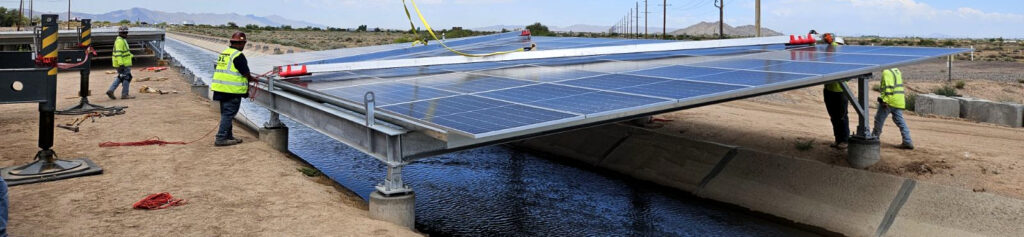
A pioneering solar installation in Gujarat, India, demonstrates how existing irrigation infrastructure can serve more than one purpose. Instead of placing photovoltaic panels on productive farmland, engineers constructed an elevated solar array above a canal—generating renewable electricity while shading and conserving the water flowing below.
Located near Chandrasan village, the approximately 2,460-foot canal-top installation was commissioned in 2012. The one-megawatt system was designed to generate about 1.6 million kilowatt-hours of electricity annually while preventing an estimated 2.38 million gallons of water from evaporating each year. Because the panels occupy the airspace above an existing canal, the project also avoids converting approximately six acres of land into a conventional ground-mounted solar facility.
One Corridor, Multiple Benefits
Canal-top solar illustrates the potential of integrated infrastructure—designing one site to provide several environmental and operational benefits.
The most direct benefit is renewable energy production without taking agricultural land out of service. This is especially important in regions where productive farmland is limited or under development pressure. By using space above canals, solar energy can be added while preserving surrounding acreage for crops, livestock, or other agricultural uses.
Shade from the panels also reduces the amount of sunlight reaching the water. This helps limit evaporation and may suppress algae and aquatic weed growth, potentially reducing some canal maintenance requirements. In certain designs, the cooler environment above the water may also help photovoltaic panels operate more efficiently, although actual performance depends on airflow, humidity, panel configuration, maintenance, and local conditions.
These combined benefits reflect a broader water-energy-food strategy: conserve water, generate energy, and protect productive land through a single coordinated project.
Engineering and Maintenance Still Matter
Despite its promise, canal-top solar is not appropriate for every irrigation system. Installing panels above moving water is more complex than constructing a conventional solar array on level ground.
Supporting structures must span the canal, resist wind and corrosion, and preserve safe access for inspections, vegetation management, sediment removal, repairs, and emergency operations. Canal width, alignment, bank stability, maintenance equipment, nearby electrical infrastructure, environmental conditions, and permitting requirements can all influence feasibility and cost.
For some sites, inexpensive land may make a traditional solar facility more economical. Canal-top systems are likely to offer the greatest value where water losses are significant, farmland is valuable, suitable open land is scarce, and electricity can be used or connected to the grid nearby.
Accordingly, large-scale projections should be treated as planning scenarios rather than guaranteed results. Each potential installation requires careful hydrologic, structural, electrical, environmental, and economic evaluation.
Relevance for Agricultural Water Management
Although the Gujarat project was developed under conditions specific to India, its underlying concept is relevant wherever irrigation infrastructure, water scarcity, land-use pressure, and energy demand intersect.
Similar projects and studies in the United States are examining whether solar-covered canals can reduce evaporation, improve water-system efficiency, limit aquatic vegetation, and generate electricity without displacing farms or natural areas. Research published in Nature Sustainability has also identified potential water, energy, and financial benefits from covering portions of major canal networks with photovoltaic panels.
For agricultural regions, the larger lesson extends beyond solar power: existing infrastructure may contain opportunities that are easily overlooked when water, energy, and land-use planning are considered separately. Reservoirs, canals, stormwater systems, irrigation networks, and energy facilities can sometimes be designed or upgraded to deliver complementary benefits.
At Royal Consulting Services, Inc., we recognize that innovative ideas must ultimately work under real-world conditions. Effective projects begin with sound site evaluation, engineering analysis, permitting, cost estimating, and long-term operation and maintenance planning. Canal-top solar is a compelling example of how integrated engineering can help communities pursue renewable energy while conserving two of agriculture’s most valuable resources—water and land.
Sources: Original Yahoo News article; Nature Sustainability research on canal-top solar.