New World Screwworm: Assessing the Threat to U.S. Agriculture, Food Supply, and Human Health
Introduction
In early August 2025, health officials confirmed the first U.S. case of New World screwworm infestation in decades, diagnosed in a Maryland resident who had recently traveled to El Salvador. While the patient has since made a full recovery and no secondary cases have been identified, the discovery has reignited debate over the risks posed by this long-eradicated parasite. Questions have arisen as to whether the screwworm could mirror the disruptive effects of highly pathogenic avian influenza (HPAI), which has reshaped animal movement, trade, and consumer prices in recent years.
Biological Background
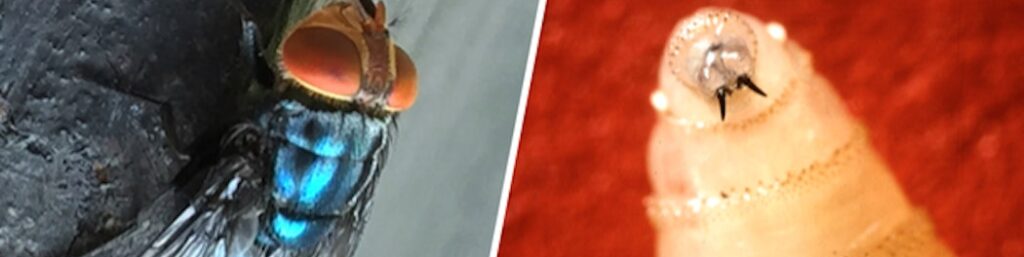
The New World screwworm (Cochliomyia hominivorax) is a parasitic blowfly native to the Americas. Its larvae infest open wounds in warm-blooded animals—including cattle, wildlife, and humans—causing a condition known as myiasis, in which maggots consume living tissue. Unlike opportunistic fly larvae that target dead tissue, screwworm larvae feed exclusively on viable flesh, resulting in painful, destructive infections that can prove fatal if untreated.
Historically, the screwworm represented one of the most devastating threats to livestock health in the United States. Following extensive losses to the cattle industry, a landmark eradication program was launched in the mid-20th century. By 1966, the U.S. had successfully eliminated the parasite using the sterile insect technique, releasing millions of irradiated, sterilized males to disrupt reproduction. A containment barrier was subsequently established in Panama to prevent reinvasion from South America.
Current Developments
The Maryland case represents an imported incident, not a domestic outbreak. According to state and federal health authorities, the patient acquired the infestation abroad, and no evidence of local transmission has been found. Nonetheless, the U.S. Department of Agriculture (USDA), in partnership with the Food and Drug Administration (FDA) and Pan-American health agencies, has intensified its surveillance and prevention measures.
Among the most significant actions:
- Expansion of sterile fly production, with a facility under construction in Texas capable of releasing up to 300 million sterile flies per week.
- Strengthened border surveillance, including detector dogs, mounted patrols, and wildlife monitoring in southern states.
- Emergency use authorizations (EUAs) for veterinary drugs to treat screwworm infestations in livestock, should cases be detected.
- Cross-border coordination with Mexico, Panama, and Central American partners to maintain eradication zones and slow northward spread.
Potential Impact
Agriculture and Animal Movement
If established, screwworm could cause catastrophic losses to the livestock industry. Economic models estimate that an outbreak in Texas alone could generate costs of $1.5–1.8 billion. Such an event would likely lead to restrictions on animal movement, heightened veterinary costs, and an urgent need for intensified eradication campaigns.
Consumer Goods and Food Supply
Unlike avian influenza, which spreads rapidly through flocks and disrupts egg and poultry markets, screwworm infestations develop in individuals rather than populations. While this reduces the likelihood of sudden mass losses, widespread establishment could still undermine meat production, indirectly affecting consumer prices. At present, there is no evidence of supply-chain disruption, though risk modeling suggests vigilance is warranted.
Human Health
Human cases of screwworm myiasis remain exceedingly rare in the U.S. and almost always involve travel-related exposures. Importantly, the parasite does not spread person-to-person. Thus, while disturbing, the Maryland case does not constitute a public health emergency. The risk to the general population remains minimal, contingent upon proper wound care and avoidance of exposure in endemic regions.
Conclusion
The New World screwworm does not appear poised to become the “next avian flu.” Its biology and transmission dynamics differ substantially from those of viral pathogens that drive pandemic scenarios. Nonetheless, the parasite represents a serious agricultural threat with potentially far-reaching economic consequences if reestablished in U.S. herds.
Federal and international agencies are pursuing aggressive, science-based strategies to prevent its return. For now, consumers and the general public face little to no direct health risk, while the livestock sector remains on high alert. The Maryland case serves as a timely reminder of the interconnectedness of global animal and human health—and the importance of continued surveillance at the agricultural–public health interface.